Take your payoff at the table
Every cook starts by poking the steak.
You press it with a finger, you guess, you cut into it, you are wrong, you adjust. Then somebody hands you a probe and you discover that the thing you had been confidently reading off your fingertip was a five degree question you had been answering with a shrug.
The finger was not lying to you. It was just low resolution.
I want to tell you about a trial that says the same thing about how you have been judging what you eat, and then I want to tell you why it is the most freeing result in this whole field.
The trial
Moschonis and colleagues published it in the British Journal of Nutrition this year. Thirty-nine adults, twelve weeks, half on a four-strain probiotic and half on an identical placebo, and nobody on either side knew which until the end.
Two things happened, and they did not agree.
The biology moved. High-sensitivity CRP, an ordinary inflammatory marker your GP can already order, came down against placebo. So did the cortisol awakening response, which is the size of the hormonal kick you get in the first half hour after your eyes open. Two separate systems, both shifted, under blinding.
And the mood scores did not move at all. Not the Beck inventory, not the PHQ, not one of them. Both groups drifted up about the same amount, which is what a placebo response looks like once somebody finally builds a trial capable of seeing one.
Thirty-nine people, twelve weeks, capsules rather than food, bloods and saliva at three points. That is what that result is made of, and it was not powered for those markers.
One caveat, and it is a real one. A triple-blind trial in Gut this year gave healthy women fermented dairy for eight weeks and found no change in mood, gut symptoms or inflammatory markers. So the inflammation result is not settled, and anyone who tells you it is has read one paper. What both trials agree on is narrower and firmer: nobody reliably felt better.
Why that is good news
Read it again, because the obvious reading is the wrong one.
The obvious reading is that it does not work. What it actually says is that something measurable happened to people who felt nothing happening.
Which means everybody who ever quit this at week six quit while it was working.
And it means something better than that. Think about why every other dietary change fails. It fails because it runs on a felt payoff. You need to notice the benefit fast enough for the noticing to keep you going, and when the noticing does not arrive, the behaviour stops. That is not weak character. That is a broken engine.
This one does not need that engine, because the biology is not waiting on your motivation. It is not scoring you weekly. It does not know whether you have been enthusiastic about it.
So you get to stop auditing yourself. And once you are not auditing, you can take your payoff somewhere it actually arrives.
Take it at the table
Here is the part a chef can tell you and a nutritionist cannot.
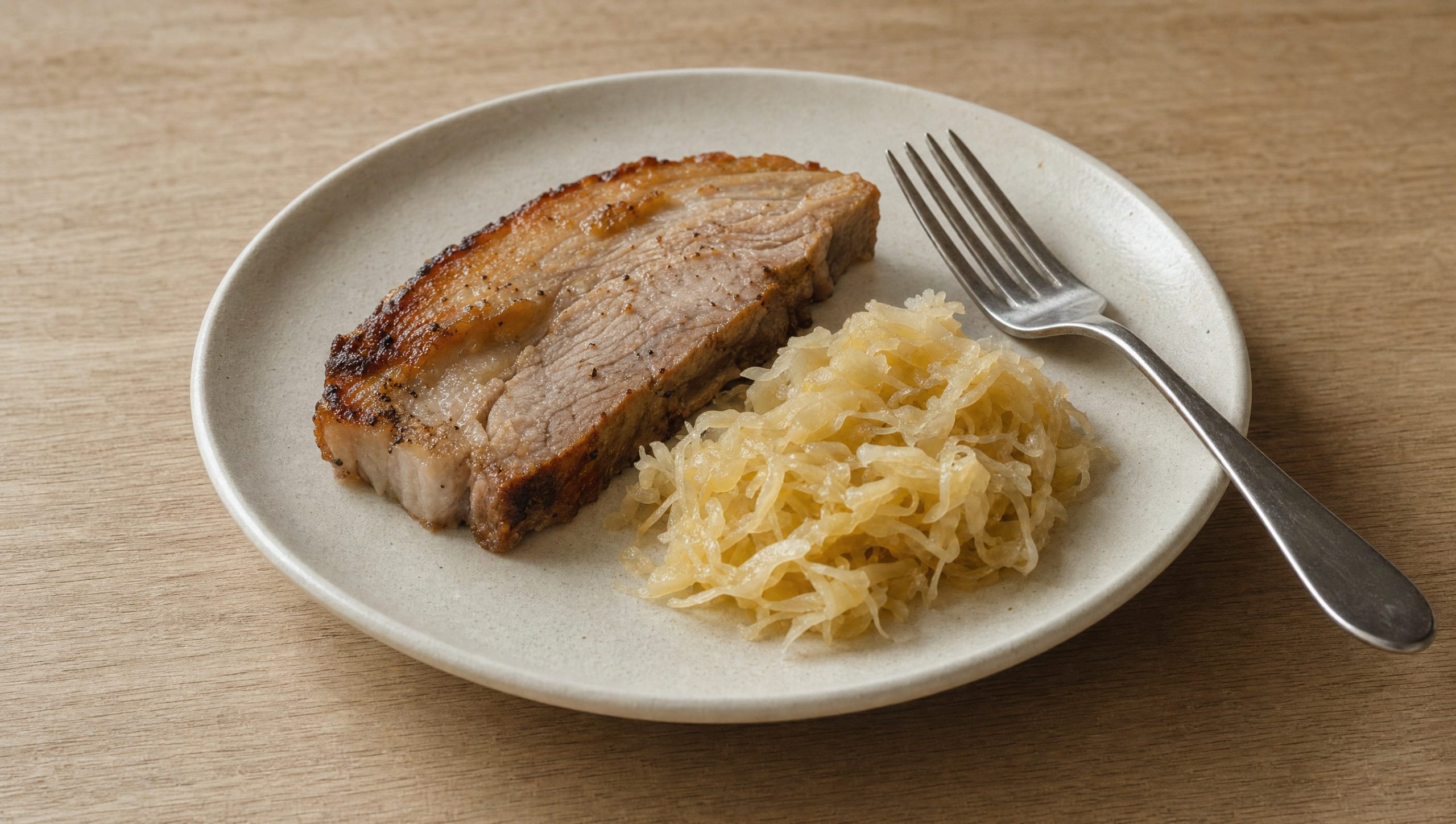
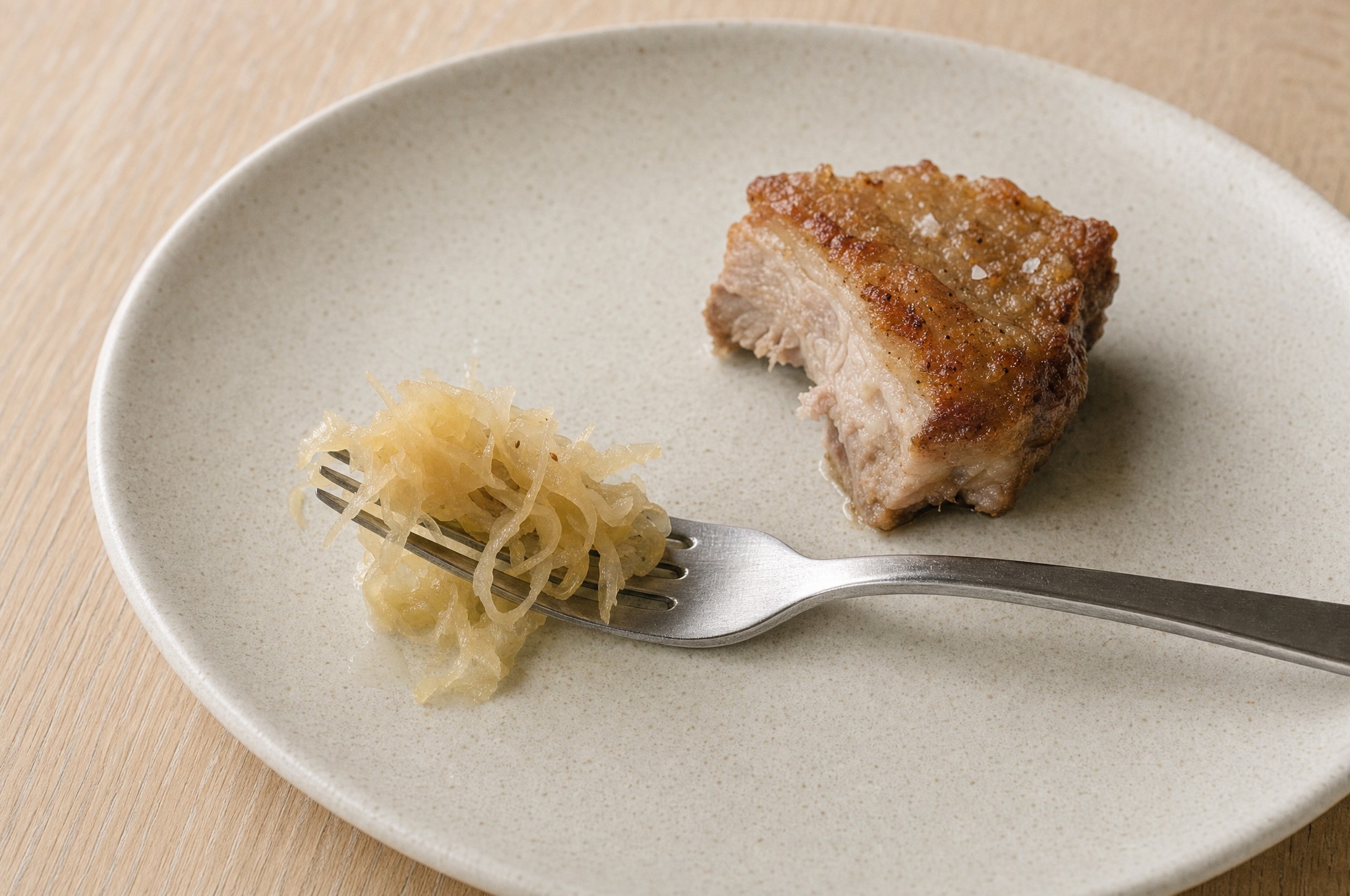
You do not need a health reason to put something sour next to dinner. Acid is one of the four things that makes food taste like food. A forkful of kraut against a fatty piece of pork does the same job a squeeze of lemon does over fish, or a cornichon next to a terrine, or pickled ginger between two pieces of sashimi. It cuts, it resets the palate, and it makes the next mouthful taste like the first one did.
That is a complete reason on its own. It was a complete reason for about four thousand years before anybody sequenced a microbiome.
The plate improves tonight. Not in twelve weeks, not on a trend line, tonight, and you will notice it because your palate is a genuinely good instrument even when your sense of your own inflammation is not.
So the deal on offer is unusually good. Do the thing for the immediate, selfish, sensory reason. The slow measurable thing happens underneath for free, on a timescale you were never going to perceive anyway, whether or not you were paying attention that week.
I have not found a better arrangement in any other part of health.
What the bacteria are actually doing while you eat well
Worth knowing, and it turns out to reinforce the same point.
When the bacteria in your large intestine work on the fibre you give them, they produce short-chain fatty acids. Butyrate is the one to know. It feeds the cells lining your gut and helps keep that barrier sealed, and a sealed barrier is a less inflamed one.
Now, everybody will tell you fibre raises your gut diversity. More species, better gut. It is in every headline because it is the easiest thing to say.
Hald and colleagues tested it properly in PLOS ONE in 2016. Nineteen adults, four weeks on a diet loaded with arabinoxylan and resistant starch, four weeks on a low-fibre Western diet, each person their own control, compliance checked against what actually turned up in their stool rather than taken on trust.
Butyrate up. Acetate up. Both comfortably beyond chance. The markers of protein fermentation down, which is the direction you want.
And species diversity went down.
The fibre did not grow a bigger zoo. It changed which animals got fed and what they made. Diversity is the metric that travels because it sounds like health. Output is the thing that leaves the gut and does work.
Which is convenient, because output responds to variety and variety is the delicious option anyway. Nobody wants the same ferment on the plate every night. Your palate and your gut want the same thing here, which does not happen often enough to ignore when it does.
Your plate, not the plate
This is where I would normally hand you a protocol. You do not need one, and a protocol would only give you something else to fail at weekly.
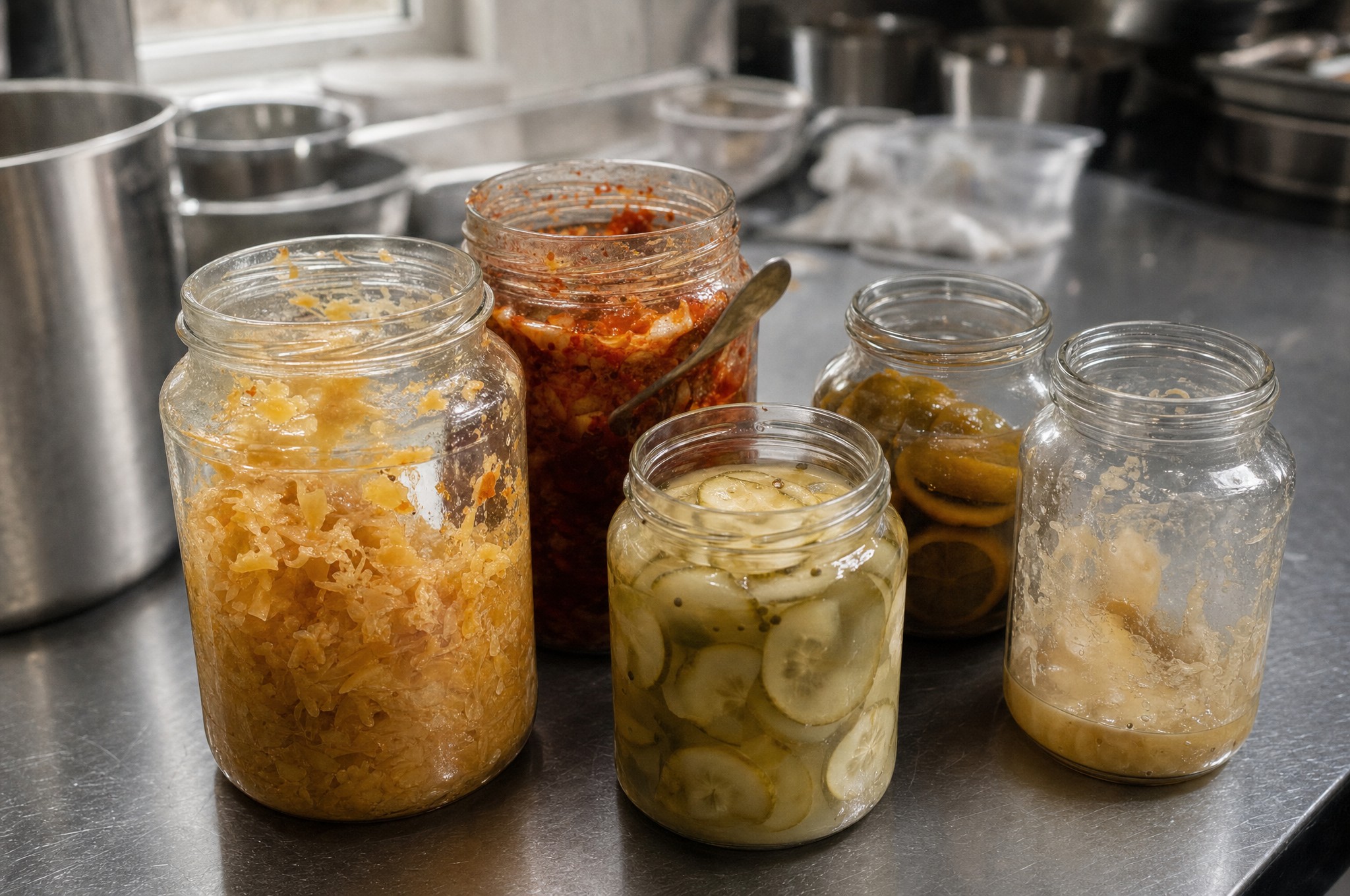
Prebiotic plants and fermented foods, varied, most days. Not from discipline. From the fact that they make dinner better and dinner happens anyway.
And your plate already has a shape. Yours might have something sour on the side most nights and no yoghurt anywhere in it. Someone else’s is the exact reverse. Both work, because the variable is not which ferment you landed on, it is whether the inputs keep arriving and keep changing.
If you want the method, the Neutral Base Method runs at 2 per cent salt by total weight. On a 1.2 kilogram cabbage that is 24 grams, a heaped tablespoon. Days, not weeks. If you would rather buy the jar, buy the jar. The gut has no opinion about whose kitchen it came from.
Tonight, for free
Cook whatever you were going to cook. Before you sit down, put a small pile of something sour on the edge of the plate. Kraut, kimchi, a quick pickle, cornichons out of a jar, whatever is in the fridge.
Eat three or four mouthfuls of the main thing. Then take a forkful of the sour thing. Then go back to the main thing.
That fourth mouthful will taste closer to the first one than it had any right to.
That is the payoff, it costs nothing, it arrives in about ninety seconds, and it is the reason to keep doing this. Everything measurable is happening in the background on its own schedule.
What actually changes
Not the food. Where you collect.
You stop waiting on a feeling that the best trial we have says will not arrive, and you start taking a real one at the table instead. And if you ever do want the number, a CRP test costs about what a decent bottle of wine costs. Get one now, another in six months, and you will know more than any amount of checking in with yourself can tell you.
The honest limit sits here. This is food, and food is for holding a system steady rather than rescuing one. A genuinely bad stretch, the kind that does not lift, is a conversation with a doctor, and no amount of cabbage substitutes for that.
But for the ordinary business of eating well across a long life, you have been handed a rare deal. The version that tastes best is also the version that works, and you do not have to feel it working for it to count.
If you want what runs underneath all of this, start with the wire between the gut and the head.
—
References
- Moschonis, G., Sarapis, K., Resciniti, S., et al. (2026). Evaluation of a probiotic blend on psychosocial health and biomarkers of inflammatory, immune and stress response in adults with subthreshold depression: a double-blind, randomised, placebo-controlled trial. British Journal of Nutrition, 135(5), 481-495. https://doi.org/10.1017/s0007114524001703
- Marx, W., Suo, C., Dissanayaka, T., et al. (2025). Effects of a probiotic fermented dairy product on hippocampal metabolites, structure and function: an 8-week randomised, placebo-controlled trial in healthy women. Gut, 75(3), 511-520. https://doi.org/10.1136/gutjnl-2025-335398
- Hald, S., Schioldan, A. G., Moore, M. E., et al. (2016). Effects of arabinoxylan and resistant starch on intestinal microbiota and short-chain fatty acids in subjects with metabolic syndrome: a randomised crossover study. PLOS ONE, 11(7), e0159223. https://doi.org/10.1371/journal.pone.0159223
- Wastyk, H. C., Fragiadakis, G. K., Perelman, D., et al. (2021). Gut-microbiota-targeted diets modulate human immune status. Cell, 184(16), 4137-4153. https://doi.org/10.1016/j.cell.2021.06.019

Field Notes Weekly
One Field Note. Every Monday. Mechanism first, no wellness language.